
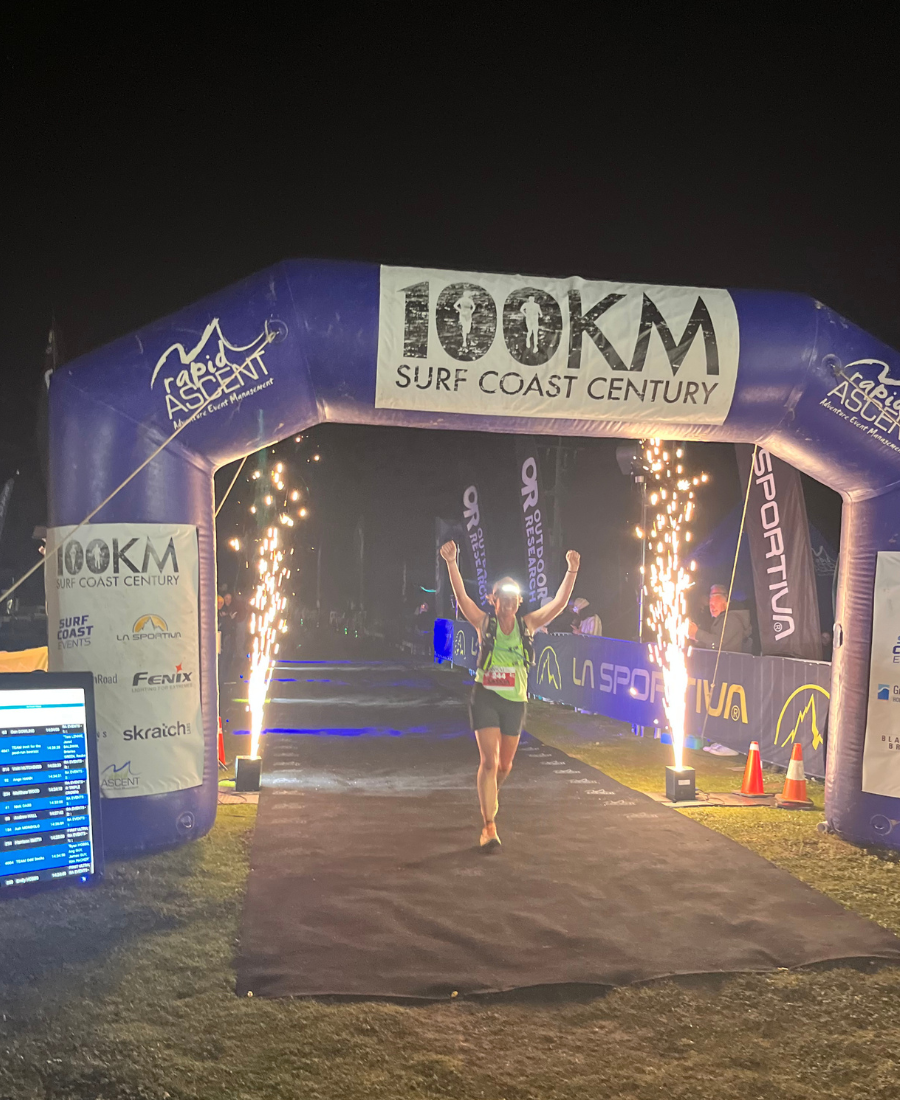
On Saturday 12 September 2026, I ran my first ever 100km ultra, the Surf Coast Century, finishing in 14 hours, 39 minutes and 42 seconds.
And somehow, after running 100km, I actually didn’t feel completely exhausted at the finish line.
My toes were another story. My knees had taken a beating. I’d kicked what felt like hundreds of rocks and tree roots and had a couple of stacks along the way. A week and a half later, two toenails are getting darker by the day!
But energy wise? I felt really good. I honestly think one of the biggest reasons was that I absolutely nailed my fuelling.
The 100km wasn’t something I jumped into overnight.
My lead up included six half marathons, two full marathons and a 50km trail ultra at official events, plus around 80–100km of training each week for the 10 or so weeks leading into the Surf Coast Century (except for the last 2 weeks were I really tapered a lot).
But the physical training was only one part of my preparation. About four weeks out, I started thinking seriously about how I was going to fuel my body for what I was asking it to do.
And basically, I started eating A LOT.
Over those final four weeks I put on around 3kg. I was eating big meals and snacking between them. Lots of oat based protein balls, fruit, banana and date muffins, plus good protein and fibre based meals.
It was all still very much within the way I eat in Phase 3 of my Gut Reboot. Plenty of whole foods, protein, fibre and variety, just a lot MORE of it.
I knew from previous long runs that my body doesn’t tolerate huge amounts of food while I’m running. So rather than relying entirely on getting enough energy into me during the event, I wanted to go into that 100km with my stores high.
From about a week out, I started drinking plenty of fresh orange juice and coconut water. I also started eating a couple of lollies each day. I don’t normally eat any refined sugar, and I knew I’d be relying on some very sugary foods during the run, so I wanted my gut to have a little exposure beforehand.
I also started drinking tablet based electrolytes.
Wednesday night was my last meal containing vegetables or salad.
For Thursday and Friday, I moved away from my usual high fibre way of eating and focused on simple, easy to digest carbohydrates. White sourdough with banana and salt, chicken with pasta, chicken with white rice.
This was not about eating for my microbes for a couple of days. This was about eating for 100km of running. Thursday I ate stacks, then on the Friday (day before) I only had 3 small meals – I wanted my bowels to be fairly empty for the day.
My pre race breakfast was simple: a white sourdough roll with banana, honey and salt. I also drank a Powerade before starting.
Then it was time to run.
There were seven checkpoints throughout the Surf Coast Century and I was incredibly lucky to have the best support crew meeting me with my food. I kept everything simple and ate small amounts at a time.
Watermelon pieces sprinkled with salt were fantastic. I had oranges slices. Across the entire 100km, I think I only ate about one and a half white bread sandwiches with banana, honey and salt.
And then there was my surprise winner of the day: sushi. Small pieces of tuna and avocado sushi with white rice were incredibly easy to chew and swallow. The white rice gave me an easy source of carbohydrate, while the small size meant I could actually get it down without feeling like I was forcing myself to eat.
I carried a bag of mixed lollies throughout the run, but this taught me something for next time.
The jelly style lollies, particularly red frogs and snakes, were surprisingly difficult to eat while running. They got stuck in my teeth, were hard to chew and I found myself coughing when trying to swallow them.
Some of the bananas and little disc shaped candy lollies that weren’t as chewy were much easier.
Lesson learnt. Next ultra, fewer chewy jellies!
I made sure I drank loads of water throughout the entire run. I was needing to pee at almost every aid station, which reassured me that I was continuing to take fluids in regularly. And would smash poweraid at each station.
And importantly, I never had that huge energy crash I was worried might come. My energy felt remarkably consistent throughout the 100km.
Looking back, I’m genuinely so happy with how my fuelling went.
I deliberately ate more in the month beforehand. I accepted gaining a few kilos as part of preparing my body for an enormous endurance event. I reduced my fibre in those final couple of days. I went into the race well fuelled, then kept carbohydrates, fluids and salt coming in throughout the day in forms I knew my stomach could handle.
For someone who spends so much of her life talking about fibre, gut microbes and whole foods, running 100km was a really interesting reminder that nutrition also needs to match what you are asking your body to do.
My body handled the 100km incredibly well from an energy perspective.
My toes? Not so much.
I crossed that finish line in 14:39:42 and, incredibly, didn’t feel completely exhausted.
Maybe I should have run faster. 😂💙